
North America, North America
The United States has long-standing constitutional structures, independent courts, and a dense network of oversight bodies that generally support state legitimacy and rule enforcement. Federal and state laws, a professional civil service, and routine elections provide formal integrity safeguards. However, widening partisan polarization, disputes over election administration since 2000, and unequal policing and incarceration patterns undermine per...
Australia and New Zealand, Oceania
New Zealand has long-standing democratic institutions, relatively low corruption, and generally effective enforcement of laws. Since the 1950s, regular competitive elections, peaceful transfers of power, and an independent judiciary have supported state legitimacy. Institutions such as the Serious Fraud Office, Auditor-General, and Ombudsman provide checks on abuse. Rule of law indicators from global bodies consistently place New Zealand among th...
Latin America, South America
Since 1950, Peru has alternated between authoritarian rule, internal conflict, and democratic openings, producing a fragile sense of state legitimacy. The 1993 Constitution and subsequent reforms created formal checks and balances, but recurring corruption scandals have badly eroded trust. Since 2016, multiple presidents and senior officials have been investigated or removed for corruption, and repeated presidential impeachments have deepened per...
Australia and New Zealand, Oceania
Since the 1950s New Zealand has developed a high-income, relatively egalitarian economy with strong social protection and low unemployment by OECD standards. Legal frameworks guarantee minimum wages, collective bargaining rights, anti-discrimination protections, and an extensive welfare and pension system. Outcomes include relatively low material deprivation, but high housing costs, persistent child poverty for low-income and Māori and Pacific ho...
Latin America, South America
Since the 1990s, Peru has seen sustained growth, falling poverty, and expansion of basic services, but livelihoods remain highly unequal and vulnerable. The constitution protects property and economic freedoms, and social protection schemes like Juntos, Pensión 65, and Contigo target poor and vulnerable households. However, informality affects over 70 percent of workers, especially in rural and Indigenous areas, limiting access to labor rights, p...
Middle Africa, Africa
Angola has a legal framework for labor rights and social protection, and oil revenues fund public investment, but this has not translated into broad-based, dignified livelihoods. Since the 1990s, economic growth has been highly dependent on oil, creating volatility and limited job creation outside the capital. Structural reforms since around 2017 aim to diversify the economy and improve business conditions, yet unemployment, particularly among yo...
Australia and New Zealand, Oceania
New Zealand has a generally robust and plural information environment, with strong legal protections for free expression and an active, competitive media sector. Since the 1990s, public broadcasters, private outlets and Maori media have expanded digital offerings, supported by high internet penetration and initiatives to counter online harm. However, consolidation of major media companies, financial stress in newsrooms, and the closure or downsiz...
Latin America, South America
Peru's information ecosystem has expanded since the 1990s with constitutional guarantees for freedom of expression and a diverse private media sector, including fast-growing digital platforms. However, repeated political crises since 2016, presidential impeachments, and the 2022-2023 unrest have intensified polarization and distrust of both media and state institutions. Structural safeguards exist, but journalists face assaults, harassment, and s...
Middle Africa, Africa
Since independence in 1975, Angola's information space has been dominated by the executive and the ruling MPLA, with state media historically aligned to government narratives. The 2010 Constitution and media laws restructured the sector, and a 2017 press law package formally abolished criminal defamation but preserved broad provisions against "insult" and dissemination of "fake news" that can be used against critics. Independent outlets and onlin...
Australia and New Zealand, Oceania
New Zealand has a long-established, independent judiciary with strong constitutional and legal safeguards, generally effective courts, and comparatively low levels of impunity for ordinary crime. Access to legal aid and community law centres helps many people, but cost, delay, and complexity still limit access, especially for low-income, Maori and Pacific communities. Oversight institutions, including the Ombudsman and Independent Police Conduct ...
Latin America, South America
Peru has a formal justice system with constitutional guarantees of judicial independence, a Constitutional Court, and human rights ombudsman, as well as transitional justice institutions created after the internal armed conflict (1980-2000). The Truth and Reconciliation Commission (2001-2003) documented serious abuses and recommended prosecutions and reparations, and some high-profile convictions occurred, including former President Alberto Fujim...
Middle Africa, Africa
Angola has a formal constitutional framework for judicial independence and a broad amnesty-based peace settlement after the civil war, but practical justice and accountability remain limited. Courts are formally separate from the executive, yet international assessments and domestic NGOs highlight persistent executive influence, corruption, and very slow case processing, particularly outside Luanda. Transitional justice for civil war abuses has l...
Australia and New Zealand, Oceania
New Zealand has had no civil war or organized armed conflict on its territory since 1950. Defense forces have deployed abroad but large-scale violence has not taken place domestically. The country experienced a major terrorist attack in Christchurch in 2019, after which Parliament rapidly tightened firearms laws and created new counterterrorism tools, contributing to a further decline in gun ownership and tightening access to semi-automatic weapo...
Middle Africa, Africa
Angola has been formally at peace since the 2002 end of its long civil war, and there is currently no active large-scale armed conflict or recognized terrorist campaign. UCDP and ACLED data for the 2010s and early 2020s show very low levels of battle-related deaths, with only scattered political or communal incidents. Homicide rates are moderate by regional standards, though reliable nationwide figures are limited, and armed robbery and small-arm...
Latin America, South America
Peru does not face nationwide civil war, but it continues to experience localized armed violence. Since the early 2000s, the Shining Path insurgency has been reduced to a small narcoterrorist faction operating mainly in the VRAEM region, where sporadic attacks on security forces and civilians still occur, including deadly ambushes in 2020-2023. Organized crime related to cocaine trafficking and illegal mining fuels lethal violence in border and j...
 Live Intelligence
Emerging Issues & Trends
Linking current developments to the PeaceMappers framework — selective signals from the systems that hold societies together.
Global Pulse / Live
Our intelligence layer continuously surfaces the developments reshaping peace, stability and resilience worldwide — curated through the PeaceMappers framework.


Who We Are
PeaceMappers is an independent global peace intelligence initiative developed by Veridian Urban Systems. It brings together analysts, historians, diplomats, policy advisors, data scientists, and former public officials with experience across fragile, transitional, and stable contexts.
Our work is grounded in a shared commitment to treating peace as a measurable, governable, and systemic condition. We reject approaches that reduce peace to aspiration, symbolism, or post-conflict recovery alone. Instead, PeaceMappers focuses on the structures, relationships, and institutional alignments that allow societies to sustain stability under pressure and manage conflict without rupture.
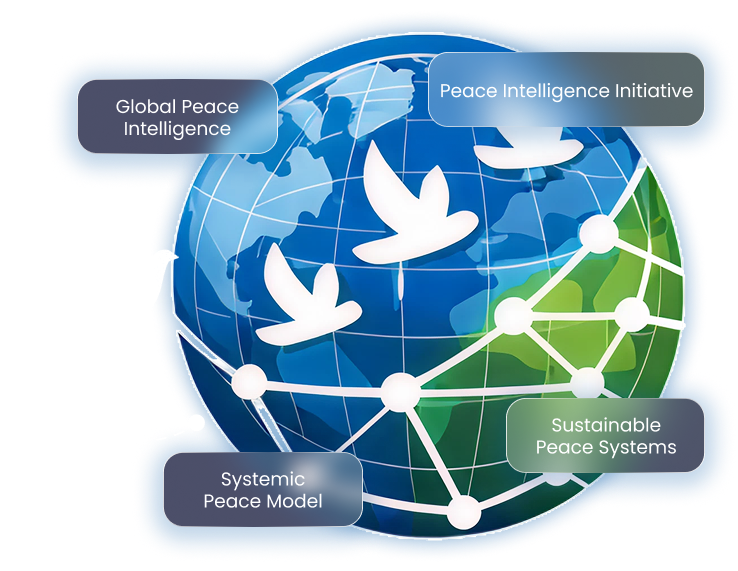

Study why peace is possible, not merely why conflict emerges. Conflict erupts from countless variables, but peace endures through a finite set of enabling conditions.

Historical Memory and Narrative Legitimacy
Assesses how societies interpret their past and whether dominant historical narratives command broad legitimacy. Where historical memory is fragmented, selectively politicized, or institutionally unresolved, grievance remains structurally available for mobilization. The issue is not consensus over history, but whether disputes over the past are governed through credible institutions rather than exclusionary politics, coercion, or violence.
Moral Order and Social
Norms

Informal Authority and Customary Mediation
Evaluates the role of elders, traditional leaders, and community-based mediation mechanisms. These structures often resolve disputes and stabilize communities where formal institutions are weak or distant. Peace is more sustainable where informal authority complements state systems and retains social legitimacy, rather than being marginalized, captured, or violently displaced.A systemic framework that identifies and maps the foundational conditions that enable societies to sustain stability, trust, and orderly coexistence.
Identifies the structural conditions that hold societies together under pressure.
Flags institutional, social, and political fractures before escalation.
Measures coherence, legitimacy, and delivery across public systems.
Tracks trust, inclusion, and social resilience as measurable assets.
Assesses a system’s capacity to withstand shocks without breakdown.
Converts complex indicators into executive-level intelligence.
Guides leaders toward preventive action, sequencing, and sustained peace.
Most conflict analysis concentrates on episodes of violence, escalation triggers, or post-crisis response. PeaceMappers operates upstream. We examine the structural, institutional, social, moral, economic, and informational conditions that allow societies to absorb stress, manage disagreement, and adapt without rupture.
Our work is diagnostic, comparative, and forward-looking. We map peace as a systemic condition, not an outcome, enabling earlier insight, better sequencing of interventions, and more durable diplomatic and policy decisions.
covering historical, moral, institutional, economic, environmental, security, and informational domains. Rather than treating these domains in isolation, PEM focuses on their interaction, alignment, and balance.
Each pillar is assessed through structured diagnostic questions and relational indicators, allowing PEM to identify:
PEM does not rank countries for publicity. It provides intelligence for prevention, diplomacy, and long-term stability.
PEM does not rank countries for publicity. It provides intelligence for prevention, diplomacy, and long-term stability.
It is a long established fact that a reader will be distracted by the readable content of a page when looking at its layout.

Commission a structured, expert-driven evaluation of a city using the Veridian Urban Index framework.
Explore indices, dashboards, and comparative analytics across cities, pillars, and time.
It is a long established fact that a reader will be distracted by the readable content of a page when looking at its layout.